

When Does Daylight Saving Time Start and End in the USA? Full 2026 Guide
Every year, millions of Americans search the same question: when does Daylight Saving Time start and end in the USA? It is one of the most consistently searched seasonal topics because the clock change affects work schedules, school mornings, flights, meetings, sports, and sleep routines.
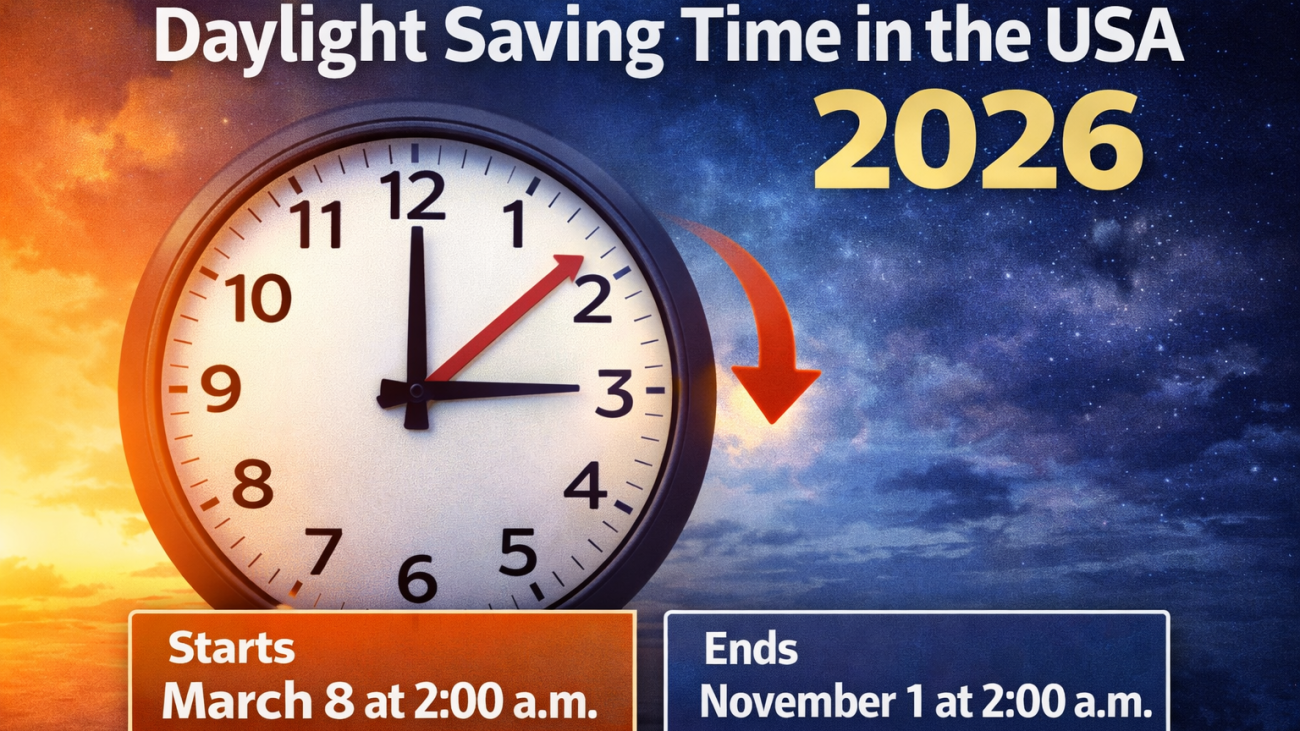
In 2026, Daylight Saving Time begins on Sunday, March 8, at 2:00 a.m. local time. At that moment, clocks move forward one hour, which is why people say “spring forward.” Daylight Saving Time ends on Sunday, November 1, at 2:00 a.m. local time, when clocks move back one hour, often called “fall back.” These dates follow the standard U.S. rule: DST starts on the second Sunday in March and ends on the first Sunday in November.
What Is Daylight Saving Time?
Daylight Saving Time, often shortened to DST, is the seasonal clock adjustment used across much of the United States. During DST, clocks are set one hour ahead of standard time. The idea is to shift more daylight into the evening hours during the warmer months.
When DST starts, the local clock jumps from 2:00 a.m. to 3:00 a.m., so people lose one hour that night. When DST ends, the clock moves from 2:00 a.m. back to 1:00 a.m., so that hour repeats.
When Does Daylight Saving Time Start in 2026?
For 2026, the official start date is:
Sunday, March 8, 2026, at 2:00 a.m. local time
That means most people in the United States need to move their clocks forward by one hour before going to sleep on Saturday night, or let their phones and smart devices update automatically. The U.S. government time service, Time.gov, also notes the same March 8, 2026 changeover.
When Does Daylight Saving Time End in 2026?
For 2026, the official end date is:
Sunday, November 1, 2026, at 2:00 a.m. local time
At that time, clocks go back by one hour. This gives people one extra hour that night, but it also means sunset comes earlier in the evening afterward.
Why Do Americans Change the Clocks?
Many people assume the clock change is about farming, but modern DST rules are simply part of the U.S. timekeeping system. The current national schedule is maintained through official federal time standards, and agencies like NIST publish the annual DST dates and timing guidance for the country.
In practical terms, DST is meant to move more usable daylight into the evening during part of the year. Whether people like it or not, the system affects daily life in a big way, especially for commuting, school, scheduling, travel, and digital calendars.
Do All States in the USA Follow Daylight Saving Time?
No. Not every part of the United States follows Daylight Saving Time in the same way.
According to NIST’s official U.S. time guidance, Hawaii does not observe DST, and most of Arizona also does not observe it. Time.gov separately lists non-contiguous U.S. areas and territories with their own time treatment, which is important for anyone planning travel or remote meetings across regions.
That means if you are scheduling calls, flights, or business meetings across the U.S., it is important to double-check time zones around the March and November transitions.
What Happens at 2:00 a.m.?
This is where many people get confused.
When Daylight Saving Time starts, the clock skips:
-
1:59 a.m.
-
then directly to 3:00 a.m.
When Daylight Saving Time ends, the clock repeats:
-
1:59 a.m.
-
then back to 1:00 a.m.
So in March, the day is one hour shorter. In November, the day is one hour longer. That is the simplest way to remember it.
How to Remember the Time Change
A common phrase in the United States is:
Spring forward, fall back
That means:
-
Spring: move clocks forward one hour
-
Fall: move clocks back one hour
It is simple, memorable, and still the easiest way to avoid mistakes.
How Daylight Saving Time Affects Daily Life
Even though the clock change is only one hour, it can have a noticeable effect on everyday routines. People often feel it in:
-
sleep schedules
-
school mornings
-
work start times
-
travel plans
-
live TV and sports timings
-
international meetings
This matters even more for businesses, freelancers, and remote workers who deal with clients in different U.S. states. A missed time conversion can cause confusion, late meetings, or missed deadlines.
Is Daylight Saving Time Automatic on Phones and Computers?
In most cases, yes. Smartphones, laptops, smartwatches, and many digital systems update automatically if the correct time zone settings are enabled. But some wall clocks, microwaves, car dashboards, security systems, and older office devices may still need to be changed manually.
That is why many people still search for DST dates every year, even though most personal devices update on their own.
Quick Answer: Daylight Saving Time 2026
Here is the short version:
-
Starts: Sunday, March 8, 2026, at 2:00 a.m. local time
-
Ends: Sunday, November 1, 2026, at 2:00 a.m. local time
-
Rule: second Sunday in March to first Sunday in November
-
Reminder: spring forward, fall back
Final Thoughts
If you were wondering when Daylight Saving Time starts and ends in the USA, the answer is straightforward once you know the pattern. In 2026, clocks move forward on March 8 and move back on November 1. Because this topic returns every year and affects millions of people, it is one of the best evergreen seasonal topics for a U.S.-focused website.
Add a Comment